Ten visa and green card pathways. One standard of excellence. Kamkhadze PA handles every employment-based immigration matter with the same depth of preparation and precision of advocacy.
The O-1A visa is reserved for individuals who have reached the very top of their field — those whose achievements command national or international recognition. It is not a standard work visa; it is a designation of distinction, available only to those who can demonstrate sustained acclaim and the recognition of their peers.
Kamkhadze PA has extensive experience building O-1A petitions that succeed. From researchers with landmark publications to technology executives with a documented record of high-impact contributions, Ana Kamkhadze knows how to translate a remarkable career into a compelling, evidence-based legal petition.
O-1A holders may work exclusively for the petitioning employer but may have concurrent petitions with multiple employers. The visa may be renewed indefinitely in one-year increments as long as the underlying work continues.
CategoryExtraordinary Ability in Science, Business, Education, or Athletics
DurationUp to 3 years; renewable in 1-year increments
EmployerRequires a U.S. petitioner (employer or agent)
StandardSustained national or international acclaim; 3 of 8 criteria
ProcessingRegular or Premium (15-business-day guarantee)
Key Eligibility Criteria
Must meet 3 of 8 regulatory criteria, or demonstrate receipt of a major internationally recognized award (e.g., Nobel Prize, Olympic Medal).
1Receipt of lesser nationally or internationally recognized prizes or awards
2Membership in associations requiring outstanding achievement
3Published material about you in professional or major media
4Participation as a judge of others' work in the field
5Original scientific, scholarly, or business contributions of major significance
6Authorship of scholarly articles in professional journals or major media
7Critical or essential role for distinguished organizations
8High salary or remuneration relative to peers
Employment Visa · Nonimmigrant
O-1B Visa Arts, Film & Entertainment
Arts, Motion Picture & Television
The O-1B visa recognizes individuals who have demonstrated extraordinary achievement in the arts, or in the motion picture or television industries. Unlike the O-1A, which focuses on acclaim, the O-1B standard for arts requires a record of extraordinary achievement — a distinction that Kamkhadze PA navigates with precision.
Artists, musicians, actors, directors, choreographers, filmmakers, and entertainment professionals across every creative discipline may qualify. Petitions require a written consultation from an appropriate labor union or management organization, and Ana Kamkhadze guides clients through each step of this process.
CategoryExtraordinary Achievement in the Arts, Motion Picture, or TV Industry
DurationUp to 3 years; renewable in 1-year increments
EmployerRequires a U.S. petitioner or agent
StandardDistinction (arts) or Extraordinary Achievement (film/TV)
ConsultationRequired from appropriate union or peer group
Dual IntentRecognized — immigrant intent not a bar
Key Eligibility Criteria
Arts: demonstrate "distinction" — a high level of achievement above that ordinarily encountered. Film/TV: demonstrate "extraordinary achievement" in the motion picture or television industry.
1Lead or starring role in productions with distinguished reputations — evidenced by critical reviews, endorsements, or box-office receipts
2Critical or significant role for distinguished organizations or establishments in the field
3Record of major commercial or critically acclaimed successes in the arts or entertainment industry
4Significant recognition from organizations, critics, government agencies, or recognized experts
5High salary or remuneration substantially above that ordinarily paid to others in the field
6Performed in lead, starring, or critical capacity for distinguished productions or venues
Immigrant Visa · Green Card
EB-1A Extraordinary Ability Green Card
Permanent Residence Without an Employer Sponsor
The EB-1A is among the most powerful immigration pathways available under U.S. law. It grants permanent residence to individuals of extraordinary ability — and requires no employer sponsorship, no PERM labor certification, and no job offer. It is a self-petition, available to those at the very top of their field.
The standard mirrors the O-1A: sustained national or international acclaim, demonstrated through at least three of ten regulatory criteria. However, as an immigrant pathway, USCIS applies additional scrutiny — the "final merits determination" — evaluating whether the totality of evidence demonstrates that the individual stands among the small percentage at the top of their field. This is where the quality of legal preparation is decisive.
Kamkhadze PA approaches each EB-1A petition with the depth and specificity required to meet this elevated standard. Priority dates are current for most countries of birth, making the EB-1A one of the fastest routes to a green card for qualifying individuals.
CategoryFirst Preference Employment-Based Immigrant Visa
Self-PetitionYes — no employer sponsorship required
PERM RequiredNo — no labor certification job required
StandardExtraordinary Ability; 3 of 10 criteria + final merits
Priority DateCommonly available for most nationalities
ResultLawful Permanent Residence (Green Card)
Key Eligibility Criteria
Must satisfy at least 3 of the following 10 regulatory criteria, or demonstrate receipt of a one-time major internationally recognized award. USCIS applies an additional "final merits determination" to evaluate whether the totality of evidence establishes sustained national or international acclaim at the very top of the field.
1Receipt of lesser nationally or internationally recognized prizes or awards for excellence in the field
2Membership in associations requiring outstanding achievement as judged by recognized national or international experts
3Published material about the person in professional or major trade publications or other major media
4Participation as a judge of the work of others, individually or on a panel, in the same or an allied field
5Original scientific, scholarly, artistic, athletic, or business-related contributions of major significance in the field
6Authorship of scholarly articles in professional or major trade publications or other major media in the field
7Display of the person's work in the field at artistic exhibitions or showcases
8Performance in a leading or critical role for distinguished organizations or establishments
9High salary or other significantly high remuneration in relation to others in the field
10Commercial successes in the performing arts, as shown by box office receipts, ratings, or other indicators
Immigrant Visa · Green Card
EB-1B Outstanding Researchers & Professors
International Recognition in Academic Research
The EB-1B category provides a permanent residence pathway for researchers and professors who are internationally recognized as outstanding in a specific academic area. Unlike the EB-1A, it requires an employer petitioner and a qualifying permanent job offer — but it offers a green card without PERM labor certification, making it a faster and more direct route for academic professionals.
Qualifying employers include universities, private research institutions with documented research departments, and private companies with at least three full-time researchers. The position must be permanent — a tenure-track professorship or a comparable permanent research role.
EmployerRequired — university, research institution, or qualifying company
PERM RequiredNo — labor certification exempted
ExperienceAt least 3 years of teaching or research in the field
StandardInternational recognition; 2 of 6 criteria
ResultLawful Permanent Residence (Green Card)
Key Eligibility Criteria
Must demonstrate international recognition as outstanding in a specific academic area. Must satisfy at least 2 of the following 6 regulatory criteria.
1Receipt of major prizes or awards for outstanding work in the academic field
2Membership in associations that require outstanding achievement as a condition of membership
3Published material in professional publications written by others about the alien's work in the academic field
4Participation as a judge of the work of others in the same or an allied academic field
5Original scientific or scholarly research contributions to the field
6Authorship of scholarly books or articles in scholarly journals with international circulation in the academic field
Immigrant Visa · Green Card
EB-1C Multinational Managers & Executives
Permanent Residence for Senior Leadership
The EB-1C category provides permanent residence to senior executives and managers who have been employed abroad by a multinational company and are being transferred to, or have already transferred to, a related U.S. entity in a managerial or executive capacity. No PERM labor certification is required.
To qualify, the foreign national must have been employed by the multinational organization in a qualifying managerial or executive role for at least one year within the three years preceding the petition or admission. The U.S. entity must have been doing business for at least one year. L-1A visa holders who meet these criteria are well-positioned for EB-1C petitions.
EmployerRequired — must be a qualifying multinational entity
PERM RequiredNo — labor certification exempted
Prior Employment1 year abroad with the company within the past 3 years
U.S. BusinessMust have been operating for at least 1 year
ResultLawful Permanent Residence (Green Card)
Qualification Requirements
All four eligibility elements must be established. The EB-1C requires no PERM labor certification and no labor market test.
1Employed abroad by a qualifying entity (parent, affiliate, subsidiary, or joint venture) in a managerial or executive capacity for at least 1 year within the 3 years preceding the petition
2Seeking entry to render services in a managerial or executive capacity to the U.S. entity
3The U.S. entity must be a qualifying organization that has been doing business for at least 1 year
4A qualifying corporate relationship must exist between the foreign and U.S. entities (common ownership and control)
Immigrant Visa · Green Card · Self-Petition
EB-2 National Interest Waiver
Self-Petition Green Card for Professionals of National Importance
The EB-2 National Interest Waiver (NIW) allows professionals with an advanced degree or exceptional ability to self-petition for permanent residence — without employer sponsorship and without a PERM labor certification — on the basis that their work is in the national interest of the United States.
Under the framework established by Matter of Dhanasar (2016), USCIS evaluates NIW petitions on three factors: (1) the proposed endeavor has substantial merit and national importance; (2) the petitioner is well positioned to advance the proposed endeavor; and (3) on balance, it would be beneficial to the United States to waive the job offer and labor certification requirements. Kamkhadze PA has built NIW petitions for researchers, scientists, physicians, engineers, entrepreneurs, and creative professionals across a broad range of fields.
CategoryAdvanced Degree Professional or Exceptional Ability + National Interest
Self-PetitionYes — no employer sponsorship required
PERM RequiredNo — waived on national interest grounds
StandardDhanasar three-prong test (Matter of Dhanasar, 2016)
Priority DateCommonly available for most nationalities (India/China may have wait)
ResultLawful Permanent Residence (Green Card)
Dhanasar Three-Prong Framework
All three prongs of Matter of Dhanasar, 26 I&N Dec. 884 (AAO 2016) must be satisfied. The petitioner must also qualify under the EB-2 base category (advanced degree or exceptional ability).
1The proposed endeavor has both substantial merit and national importance — implications must extend beyond a local or regional level
2The petitioner is well-positioned to advance the proposed endeavor — track record, education, skills, progress, and support all considered
3On balance, it would be beneficial to the United States to waive the job offer and labor certification requirements
Employment Visa · Nonimmigrant
H-1B Specialty Occupation
Work Authorization for Degreed Professionals
The H-1B visa authorizes employment in a specialty occupation — one that theoretically and practically requires the attainment of at least a bachelor's degree or its equivalent in a specific field of study. It remains the principal mechanism by which U.S. employers hire foreign professionals, and is subject to an annual cap lottery.
Kamkhadze PA assists clients with H-1B initial filings, cap-exempt employer transfers, extensions, and amendments. Cap-exempt H-1B positions — those at universities, nonprofits affiliated with institutions of higher education, and governmental research organizations — are not subject to the annual lottery and may be filed at any time.
CategorySpecialty Occupation — minimum bachelor's degree in specific field
Duration3 years initial; extendable to 6 years total (with AC21 exceptions)
Cap65,000 per year + 20,000 U.S. master's exemption; annual lottery
EmployerRequired — tied to petitioning employer
Dual IntentRecognized — immigrant intent not a bar
ProcessingRegular or Premium (15-business-day guarantee)
Specialty Occupation Standard
A position qualifies as a specialty occupation if it meets at least ONE of the following four criteria under 8 CFR § 214.2(h)(4)(ii).
1A baccalaureate or higher degree (or equivalent) in a specific specialty is the normal minimum requirement for entry into the occupation
2The degree requirement is common to the industry in parallel positions among similar organizations — or the position is so complex or unique that it can only be performed by someone with a degree
3The employer normally requires a degree or its equivalent in the specific specialty for the position
4The nature of the specific duties is so specialized and complex that the knowledge required to perform them is usually associated with attainment of a baccalaureate or higher degree
The L-1 visa enables multinational companies to transfer qualifying employees from a foreign affiliate, parent, subsidiary, or joint venture to their U.S. entity. The L-1A applies to managers and executives; the L-1B applies to employees with specialized knowledge of the company's products, services, research, or procedures.
L-1A holders are eligible to apply for an EB-1C green card, creating a natural pathway from temporary work authorization to permanent residence. L-1 visas are cap-exempt and may be filed at any time. Blanket L-1 petitions are available for qualifying large multinational companies, enabling expedited processing for multiple employees.
L-1AManagers and executives — 3 years initial; 7 years maximum
L-1BSpecialized knowledge workers — 3 years initial; 5 years maximum
Prior Service1 year with the company abroad within the past 3 years
CapNo annual cap — may be filed at any time
Green Card PathL-1A holders are prime EB-1C candidates
Dual IntentRecognized — immigrant intent not a bar
Eligibility Requirements
Both L-1A (managers/executives) and L-1B (specialized knowledge) require the same four foundational eligibility elements.
1Employed by the petitioning company or a qualifying related entity (parent, subsidiary, affiliate, or joint venture) abroad for at least 1 continuous year within the 3 years preceding the petition
2The foreign employment was in a qualifying capacity: managerial or executive (L-1A) or specialized knowledge (L-1B)
3The U.S. entity and the foreign entity must share a qualifying corporate relationship — common ownership and control
4The beneficiary is coming to the U.S. to render services in a qualifying capacity for the U.S. entity
Investment Visa · Nonimmigrant
E-2 Treaty Investor
Investment-Based Work Authorization for Treaty Nationals
The E-2 Treaty Investor visa allows nationals of countries that maintain qualifying investment treaties with the United States to enter and work in the U.S. based on a substantial investment in a U.S. enterprise. The investor must direct and develop the investment and must demonstrate that the enterprise is not marginal — that it generates economic value beyond merely supporting the investor and their family.
The E-2 has no fixed minimum investment amount — "substantial" is evaluated relative to the total cost of the enterprise. However, the investment must be at risk, irrevocably committed, and the enterprise must be operational or in the process of becoming operational. E-2 status is renewable indefinitely so long as the qualifying investment continues.
NationalityMust be a national of a U.S. treaty country
InvestmentSubstantial, irrevocably committed capital — at risk
RoleMust direct and develop the enterprise
Durationdepends on the nationality of treaty country
EmployeesE-2 managers and essential employees also eligible
Green CardE-2 does not lead directly to a green card; NIW or EB-5 may be pursued consequently
Investor Eligibility Requirements
All five criteria must be established. "Substantial" investment is evaluated on a proportionality basis relative to the total cost of the enterprise.
1The investor must be a national of a country that maintains a qualifying investment treaty with the United States
2A real and active investment has been made — capital is irrevocably committed to a bona fide enterprise
3The investment is "substantial" — proportionate to the total cost of the enterprise and placed at risk
4The investor is coming solely to develop and direct the investment enterprise
5The enterprise is not marginal — it must have present or future capacity to generate income beyond a living for the investor and family
Employment Status · Nonimmigrant · USMCA
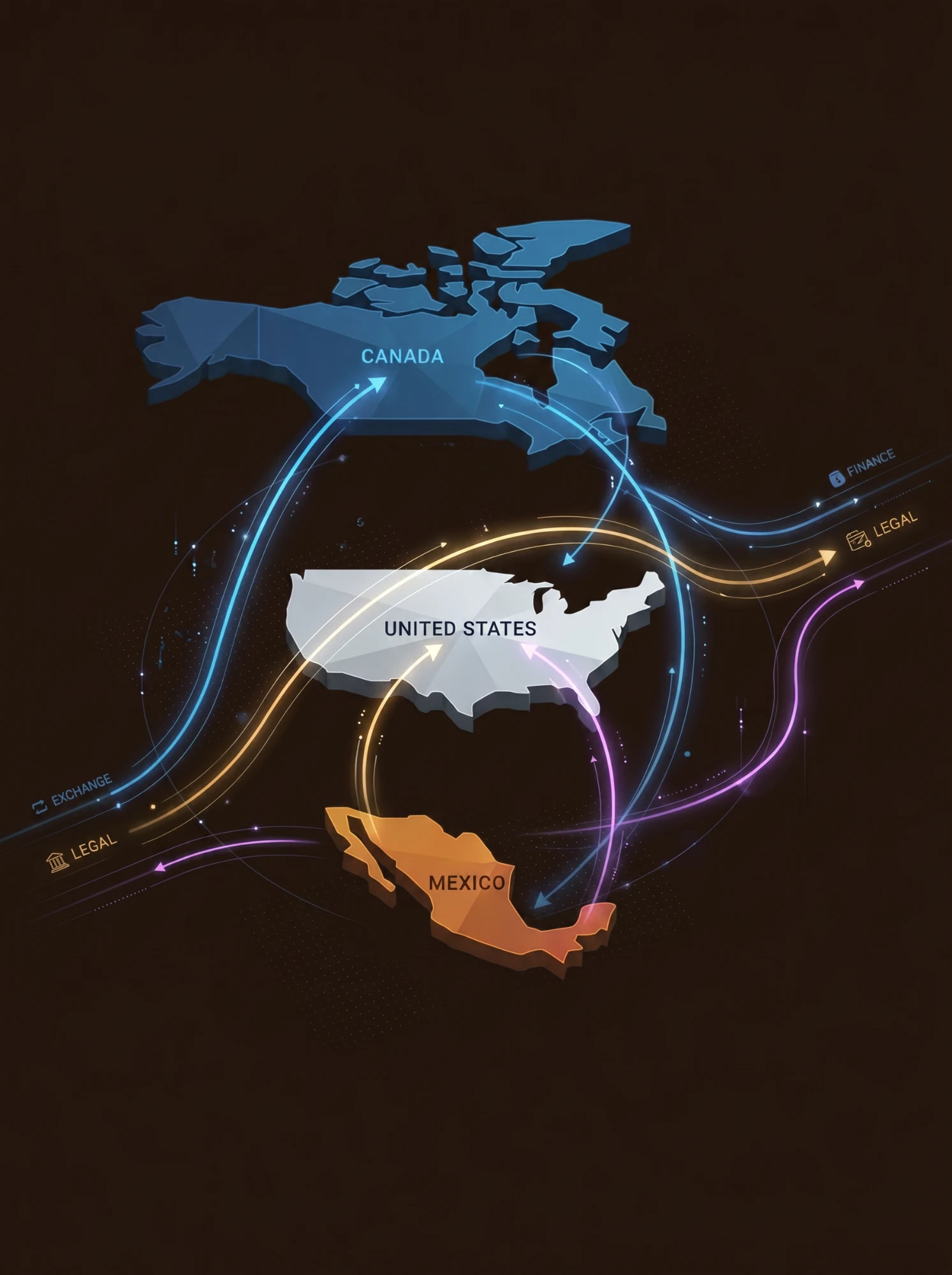
TN Status Canadian & Mexican Professionals
Professional Work Authorization Under USMCA
TN status provides nonimmigrant work authorization to Canadian and Mexican citizens employed in certain enumerated professional occupations under the United States-Mexico-Canada Agreement (USMCA). The list of qualifying professions is specific and includes accountants, engineers, scientists, lawyers, physicians (for teaching or research), management consultants, and others.
Canadian citizens may apply for TN admission directly at a U.S. port of entry; Mexican citizens must apply for a TN visa at a U.S. consulate in Mexico. TN status is granted in one-year increments and may be renewed indefinitely, though it is technically a nonimmigrant status that requires the holder to have the intent to depart upon completion of the authorized work.
Duration1 year per admission; renewable without limit
CanadiansPort of entry application — no consular visa required
MexicansConsular TN visa required before admission
CapNo annual cap
Eligibility Requirements
All four elements must be satisfied. The USMCA Appendix lists qualifying professions and their required credentials precisely.
1Citizenship of Canada or Mexico — TN is not available to permanent residents or nationals of other countries
2The position must fall within a listed USMCA TN profession (e.g., accountant, engineer, lawyer, pharmacist, scientist, teacher, management consultant)
3The applicant must possess the required credentials for the profession — typically a baccalaureate degree, or applicable licensure or credentials as specified
4A qualifying job offer from a U.S. employer must exist — or, for Canadians filing at the port of entry, employer documentation must be presented